
In this article
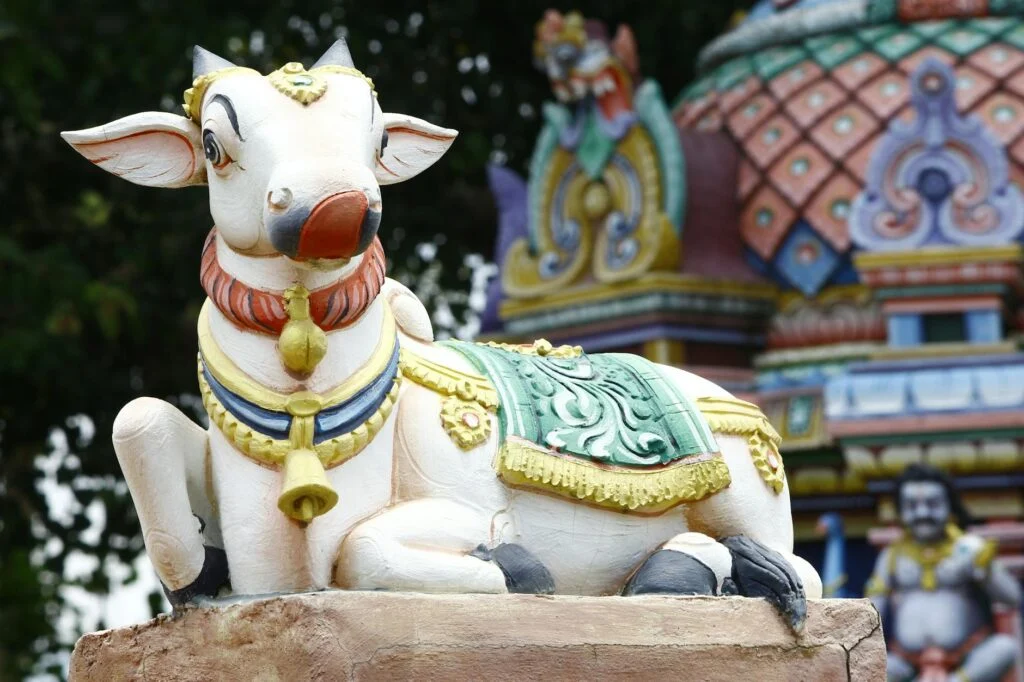
Nandi’s calm presence gives Shiva devotion a familiar face. The sacred bull is honored as Shiva’s vahana, or divine mount, and as a devoted companion. His stillness can draw a visitor into a quieter mood before the encounter with Shiva.
The name Nandi is associated with joy. That warmth matters: the bull belongs to a relationship of affection and reverence, not merely to a catalogue of temple animals.
More than a means of transport
The Denver Art Museum’s account describes Nandi as both Shiva’s vehicle and an ardent worshipper. A vahana identifies a deity’s presence, but it also has its own honored place in sacred imagery. Nandi may therefore be approached as a devotee whose attention is directed toward his lord.
A modern reflection on that posture might ask what it means to listen carefully or remain present in prayer. Such a reflection is inspired by his devotional role; it is not a promise that a particular gesture makes a prayer arrive faster.
Looking closely at a carved bull
Denver’s south Indian granite Nandi is attributed to the Chola period. Its educational account draws attention to the young bull’s expression, the turn and tilt of his head and the different positions of his legs.
Carved details include necklaces, a blanket across the back and decorative forms on the head and legs. The sculpture joins animal vitality with ceremonial dignity. His body seems quietly capable of movement even while he rests.
These details make a named object more revealing than a generic table assigning a different virtue to every feature. Looking slowly lets us notice the artist’s care: the rounded mass of the body, the shallow carving and the small gestures that give the bull character.
Jewelry made for Nandi
The Nelson-Atkins Museum holds a nineteenth-century ceremonial necklace intended for a large Nandi sculpture. Made of silver with rubies, it offers evidence that adornment was not always carved into the image; separate ornaments could be added in worship.
The museum describes jasmine-bud-like points and rounded elements resembling rudraksha seeds, the beads associated with Shiva prayer. Its label also records the honoring of Nandi sculptures with jewelry, flowers and pigment.
Such an ornament helps us imagine the difference between seeing an object alone in a collection and encountering an image cared for by worshippers. Dressing and decorating a sacred figure are acts of attention, even when arrangements vary from one temple to another.
Nandi in the divine household
In a late eighteenth-century Pahari painting at the Metropolitan Museum, Nandi appears beside Shiva, Parvati, Skanda and Ganesha. The bull and Parvati’s lion share sweets in the foreground. Here the companion belongs to a tender scene of family life.
This is a different artistic setting from the solitary granite bull. Both preserve his relationship with Shiva while showing how devotional imagination can move between stillness and affectionate activity.
Learning a temple’s own custom
Visitors can follow the guidance of the temple whose Nandi they encounter, including where to stand and whether offerings or touching are permitted. Inherited practices deserve their local context; they need not be made into one mandatory sequence for all Hindus.
Nandi’s enduring appeal lies in the simplicity of his devotion. A devoted gaze, a garland or a carefully made ornament can make reverence visible. Learning to notice those details is a fitting way to meet Shiva’s joyful companion.
Sources and further reading
See Denver’s Sacred Bull of Shiva, the Nandi necklace and the Pahari family painting.